Frequently Asked Question
ITVDesk uses standard video surveillance network protocols so that VMS, NVR, XVR and DVR systems can discover the virtual camera, connect through ONVIF, and receive live video/audio streams through RTSP, RTSPS or other configured transports.
The most important rule is simple: use the port values shown inside your ITVDesk application. ITVDesk ports can be changed for enterprise networks, protected systems, multiple virtual cameras, port-conflict situations or external access configuration.
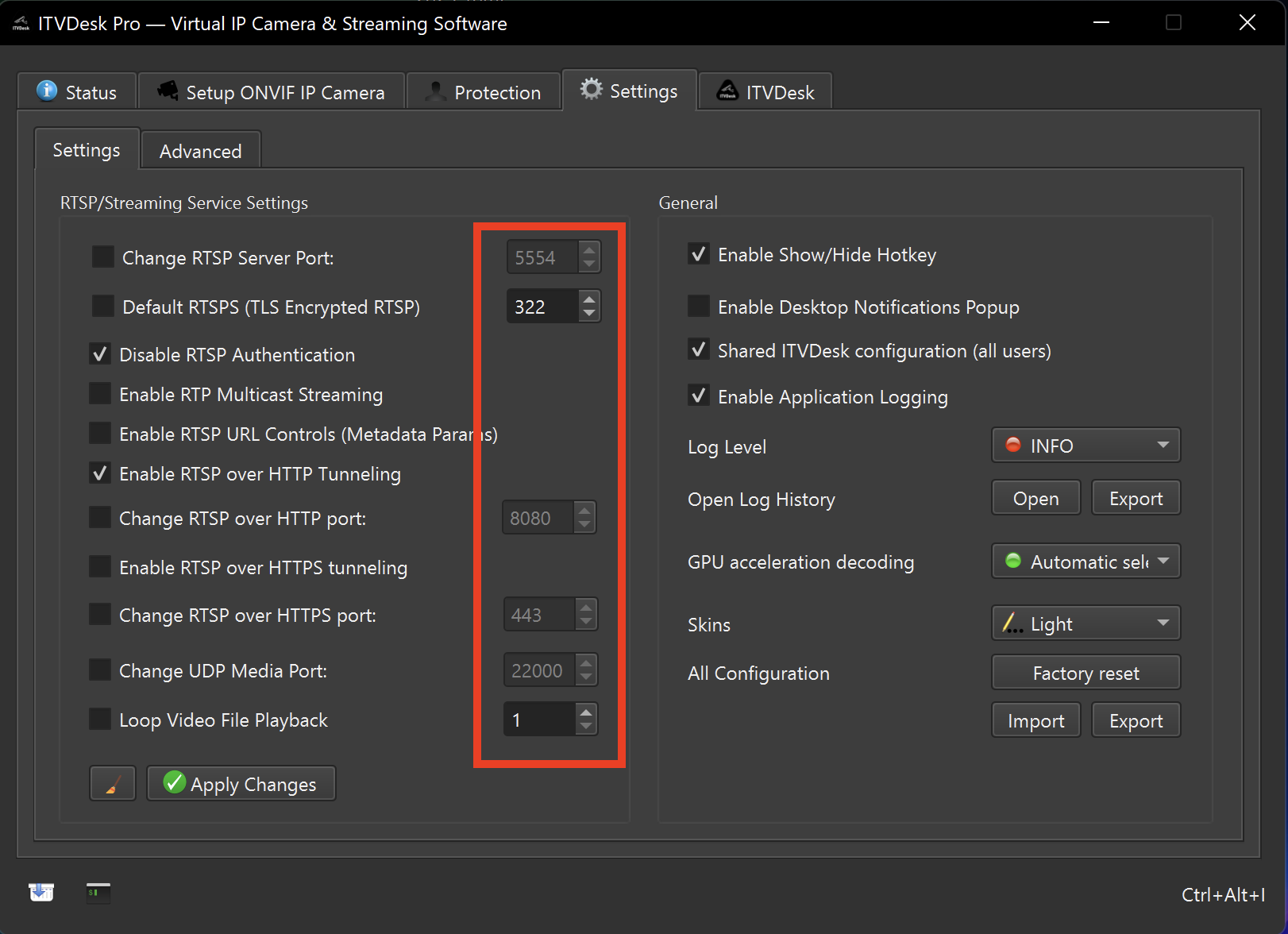
Default ITVDesk ports
The table below shows the common default ports used by ITVDesk. Your installation may show different values if the camera was configured manually, if multiple virtual cameras are used, or if secure transport options are enabled.
| Service | Protocol | Typical default | Purpose |
|---|---|---|---|
| ONVIF Discovery | UDP | 3702 | Used by WS-Discovery when a VMS/NVR searches the local network for ONVIF devices. |
| ONVIF / Web HTTP | TCP | Shown in ITVDesk, commonly 7000/7001 | Used by the VMS/NVR for ONVIF device, media, profile, user and event communication. |
| ONVIF / Web HTTPS | TCP | Next port after the ONVIF/Web HTTP port when HTTPS is enabled | Secure ONVIF/Web communication over TLS. Example: if the ONVIF/Web HTTP port is 7000 and HTTPS is enabled, HTTPS uses 7001. If HTTPS is not enabled, that next port remains free and can be used by another ITVDesk virtual camera. |
| RTSP stream | TCP | 554 | Default live video/audio stream port used by VMS/NVR systems and RTSP clients. |
| RTSPS stream | TCP / TLS | Shown in ITVDesk, commonly 322 when enabled | Encrypted RTSP transport for secure streaming where supported by the client/VMS. |
| SRT | UDP | Configured per source/stream | Used only when SRT streaming is configured for reliable transport over unstable networks. |
Note: If you add ITVDesk manually in a VMS/NVR, ONVIF Discovery (UDP 3702) is not always required. In that case, the VMS/NVR must still be able to reach the configured ONVIF TCP port and the configured RTSP/RTSPS stream port.
HTTPS port allocation: ITVDesk assigns the HTTPS port only when HTTPS is enabled for that virtual camera. The HTTPS port follows the configured ONVIF/Web HTTP port. For example, ONVIF/Web HTTP 7000 uses HTTPS 7001 when enabled; ONVIF/Web HTTP 7003 uses HTTPS 7004 when enabled. If HTTPS is disabled, the next port is not reserved.
How to check the current ITVDesk ports
- Open ITVDesk.
- Go to Setup ONVIF IP Camera.
- Select the virtual IP camera.
- Check the LAN IP address, ONVIF/Web port, RTSP URL and secure transport status shown in the camera panel.
- Click the preview/test area or use the camera test tool to confirm that the stream is reachable before adding it to the VMS/NVR.
For detailed testing steps, see the ITVDesk documentation page: Preview and test ITVDesk streams.
Windows Firewall and enterprise firewall rules
If the VMS/NVR cannot detect ITVDesk or cannot open the live stream, check local firewall rules on the ITVDesk computer and any network firewall between ITVDesk and the recorder.
Allow inbound access to the ITVDesk computer for the services you actually use:
- UDP 3702 if ONVIF auto-discovery is required on the local network.
- ONVIF/Web HTTP TCP port shown by ITVDesk.
- ONVIF/Web HTTPS TCP port if ONVIF over HTTPS is enabled.
- RTSP TCP 554 by default, or the custom RTSP port shown by ITVDesk.
- RTSPS TCP port if secure RTSP is enabled.
- SRT UDP port only when SRT is configured and required.
In managed corporate networks, firewall rules may be controlled by domain policy, endpoint protection or network segmentation. If the application works locally but not from the VMS/NVR subnet, ask the network administrator to confirm that the selected ITVDesk ports are allowed between both networks.
Secure ONVIF and secure streaming
For production and enterprise deployments, ITVDesk can use secure communication options such as ONVIF over HTTPS, RTSPS and SRTP where supported by the VMS/NVR or client software.
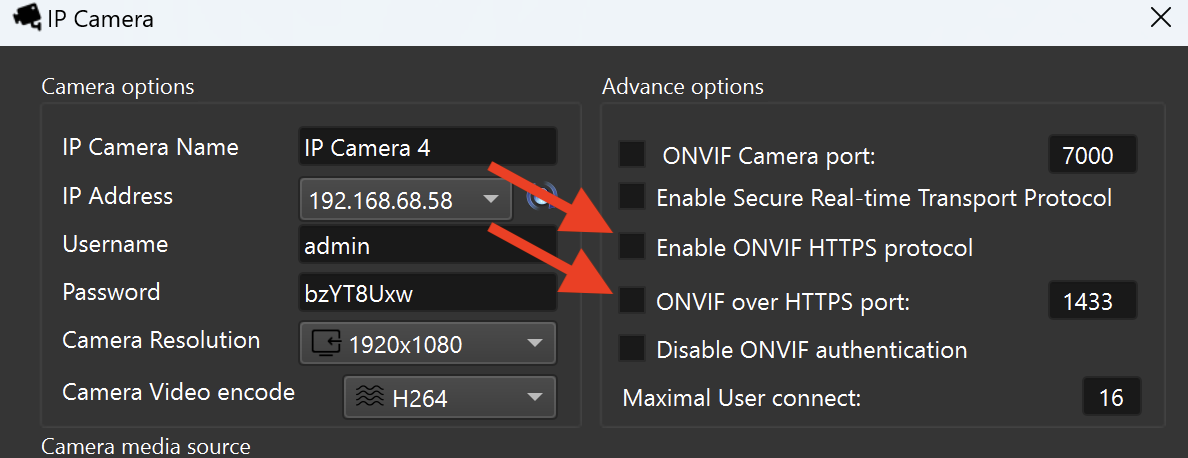
When secure transport is enabled, make sure that the secure port is opened in the firewall and that the VMS/NVR is configured to use the secure protocol. Some recorders require manual configuration for HTTPS or RTSPS and may not automatically switch from RTSP to RTSPS.
External access, router port forwarding and UPnP
ITVDesk can also be configured for access from another network when this is required. Use this carefully. Exposing camera services to the Internet should be done only when needed and preferably through VPN, a protected network, or a controlled firewall policy.
When using ITVDesk external access / UPnP configuration:
- Start the ITVDesk virtual camera first.
- Open the external access / port forwarding configuration.
- Enable external access only for the required camera.
- Select automatic UPnP if the router supports it, or create manual router forwarding rules.
- Forward only the required ONVIF/Web, HTTPS, RTSP or RTSPS ports.
- Use the validation result to check whether the UPnP mapping exists and whether the port is reachable externally.
If ITVDesk reports that router rules are configured but the port is still blocked by NAT, the network may be behind private WAN, double NAT or carrier-grade NAT (CGNAT). In that case, Internet access may require a public IP address, bridge mode, VPN, or another controlled network access method.
Security recommendations
- Use strong ONVIF/RTSP credentials.
- Expose only the ports that are required by the VMS/NVR.
- Prefer VPN or private network access instead of direct Internet exposure.
- Use HTTPS, RTSPS and SRTP where supported by your recorder or VMS.
- Disable external access or remove UPnP/router rules when they are no longer needed.
- Do not expose test or temporary ports in production environments.
Advanced and legacy port notes
Some older ITVDesk deployments or customized installations may use different port values than the current default configuration. If you are supporting an existing installation, always check the actual values shown in the ITVDesk interface before changing firewall or router rules.
| Port / range | Protocol | When it may be used |
|---|---|---|
| 7000 | TCP | Common ONVIF/Web HTTP port for the first ITVDesk virtual camera. |
| 80 / 443 | TCP | May be used for RTSP over HTTP or HTTPS-style transport scenarios, depending on configuration and network policy. |
| 22000-30000 | UDP | Optional RTSP/RTP media port range in deployments that use UDP media transport. Depending on the client and stream configuration, one RTSP session may require several UDP ports. |
If your VMS/NVR uses RTSP over TCP/interleaved transport, a separate UDP media range may not be required. If your environment uses UDP/RTP media transport, make sure the required UDP range is allowed between the VMS/NVR and the ITVDesk computer.
Port conflict example: WSAE-10013 / bind udp socket fail
If ITVDesk reports an error such as Bind udp socket fail,error = WSAE-10013 or another bind/listen error, another process, Windows service, security product, or existing camera software may already be using the required port.
On Windows, you can check which process is using network ports with Command Prompt or PowerShell. For example:
netstat -abno -p UDP
netstat -abno -p TCP
Then identify the process using the conflicting port, stop or reconfigure that process, and start ITVDesk again. If the port is intentionally used by another service, change the ITVDesk ONVIF/Web or RTSP port to a free value and update the VMS/NVR configuration accordingly.
Network Port Conflicts & Cleanup Utility
In some Windows environments, a background process, test player, security tool or closed application can keep network ports in use. This can prevent ITVDesk from starting the ONVIF, RTSP or RTSPS service even after you change the port.
If changing the port does not resolve the problem, ITVDesk provides a built-in Network Cleanup Utility for recovery situations.
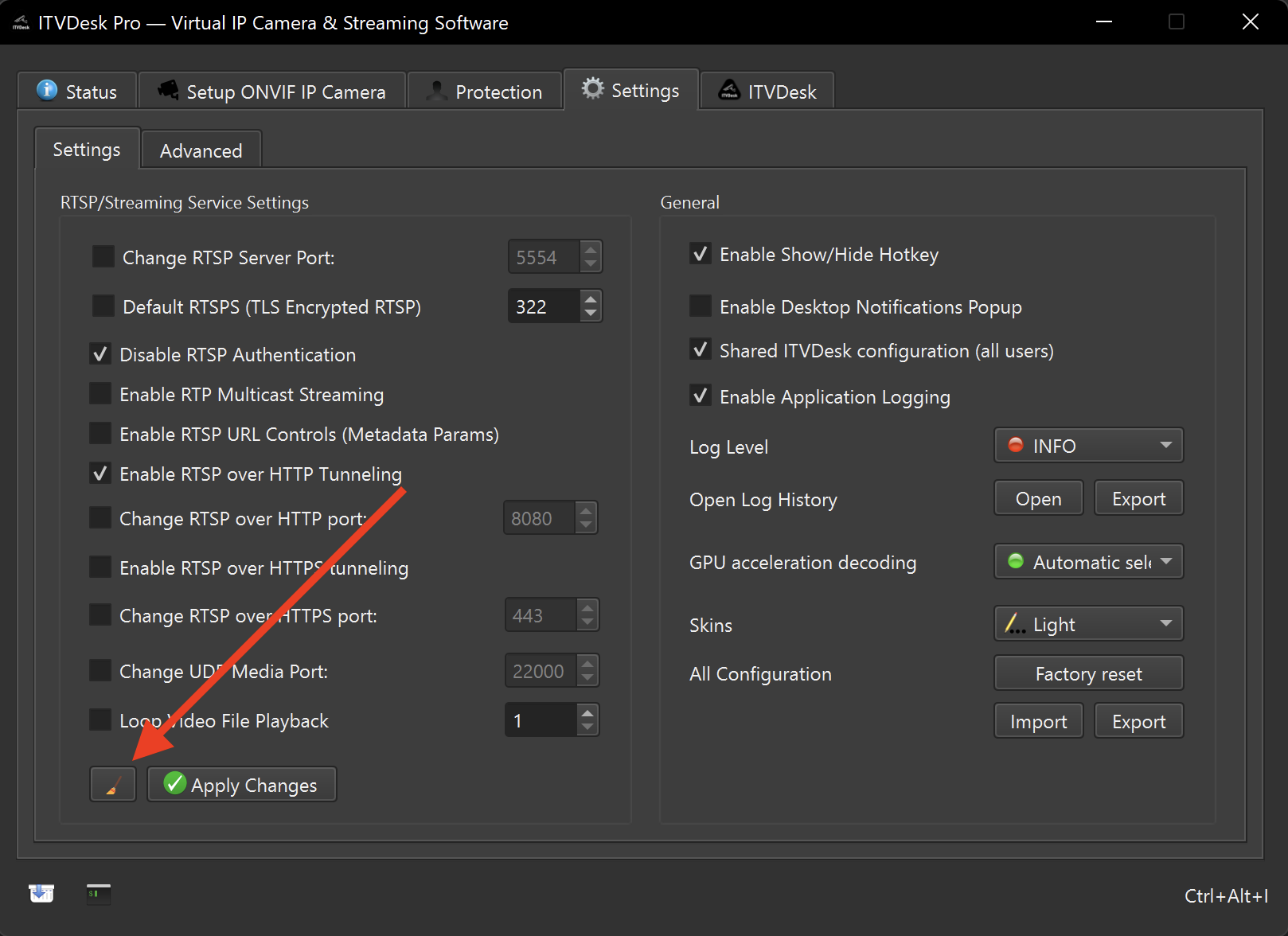
The cleanup utility can:
- terminate ITVDesk-related background processes,
- force-release blocked LISTENING network ports used by ITVDesk services,
- reinitialize Windows network listeners used for ONVIF / RTSP / RTSPS startup.
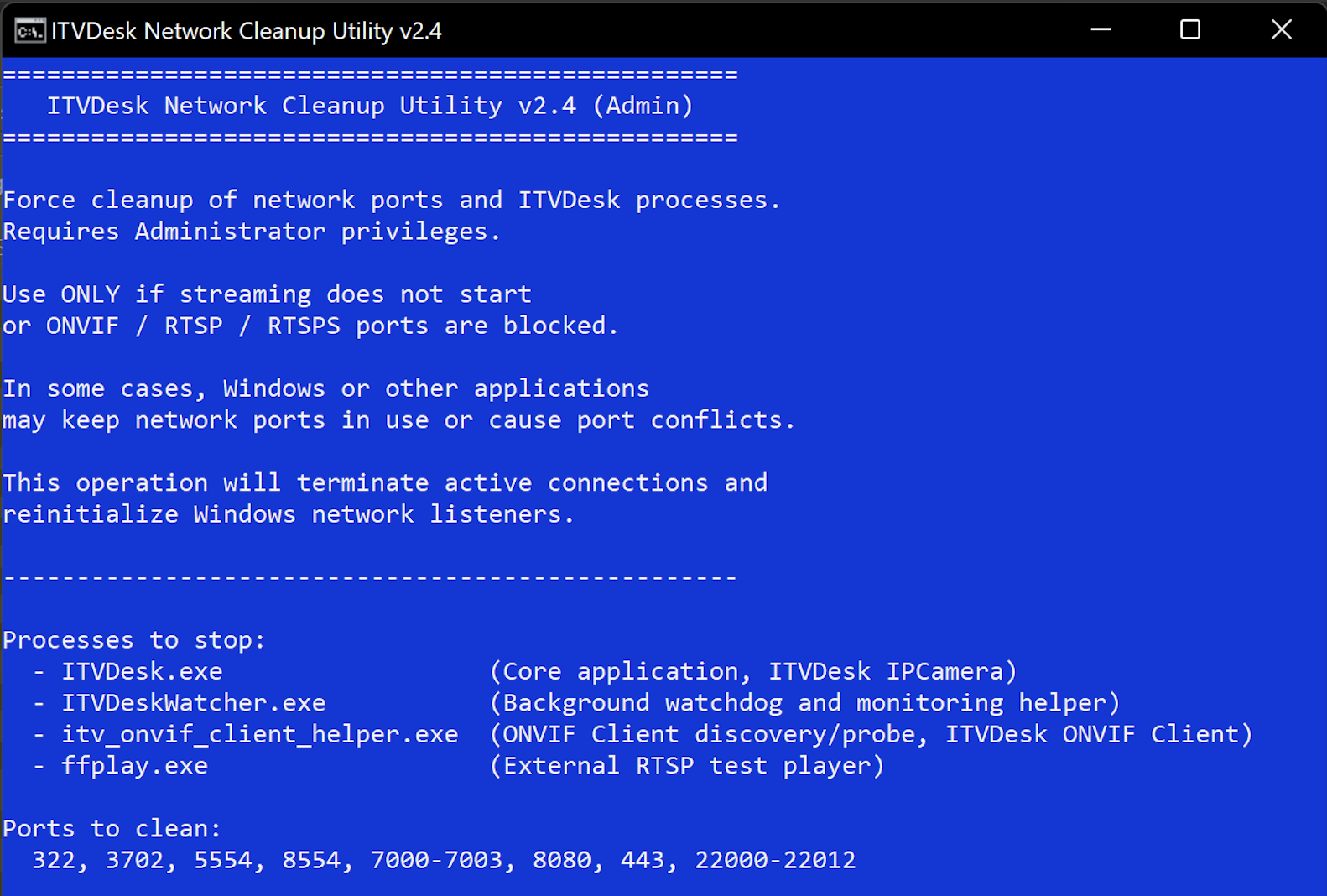
Bind UDP socket fail, error = WSAE-10013, it usually indicates a port conflict, blocked permission, firewall policy or insufficient privileges.
Before using the cleanup utility, verify that the required ports are free and accessible for your actual ITVDesk configuration:
- UDP 3702 for ONVIF discovery when auto-discovery is used.
- TCP ONVIF/Web port shown in ITVDesk, for example 7000 for the first virtual camera.
- TCP RTSP port 554 by default, unless you changed it in ITVDesk.
- TCP HTTPS / RTSPS ports only when secure transport is enabled.
- UDP media port range only if your deployment uses UDP/RTP media transport.
If the computer is managed by an organization, confirm the change with your IT administrator before running cleanup tools or changing firewall policy.
Troubleshooting checklist
If the VMS/NVR cannot discover ITVDesk or cannot display live video:
- Confirm that the ITVDesk virtual IP camera is running.
- Check the current ONVIF/Web port and RTSP/RTSPS URL shown in ITVDesk.
- Verify that the VMS/NVR uses the same IP address, port, username and password.
- Test the ITVDesk stream from the same network segment as the VMS/NVR.
- Check Windows Firewall, endpoint security and domain firewall policy.
- Confirm that no other service is using the same port, especially TCP 554.
- If using HTTPS or RTSPS, confirm that the VMS/NVR supports the secure protocol and is configured for it.
- If using external access, check UPnP/router rules, double NAT and public IP availability.
Related helpdesk article: VMS/NVR can't detect ITVDesk or live video from ITVDesk is not coming.