Frequently Asked Question
Use this article to tune ITVDesk video quality, recorder compatibility, bandwidth usage, and CPU/GPU performance for VMS and NVR integrations.
ITVDesk can expose each virtual camera as one or more video stream profiles, similar to professional IP cameras. Each profile can have its own resolution, codec, FPS, GOP / encoding interval, bitrate, and quality settings. This lets you use a high-quality stream for recording and a lighter stream for preview, remote access, or low-bandwidth networks.
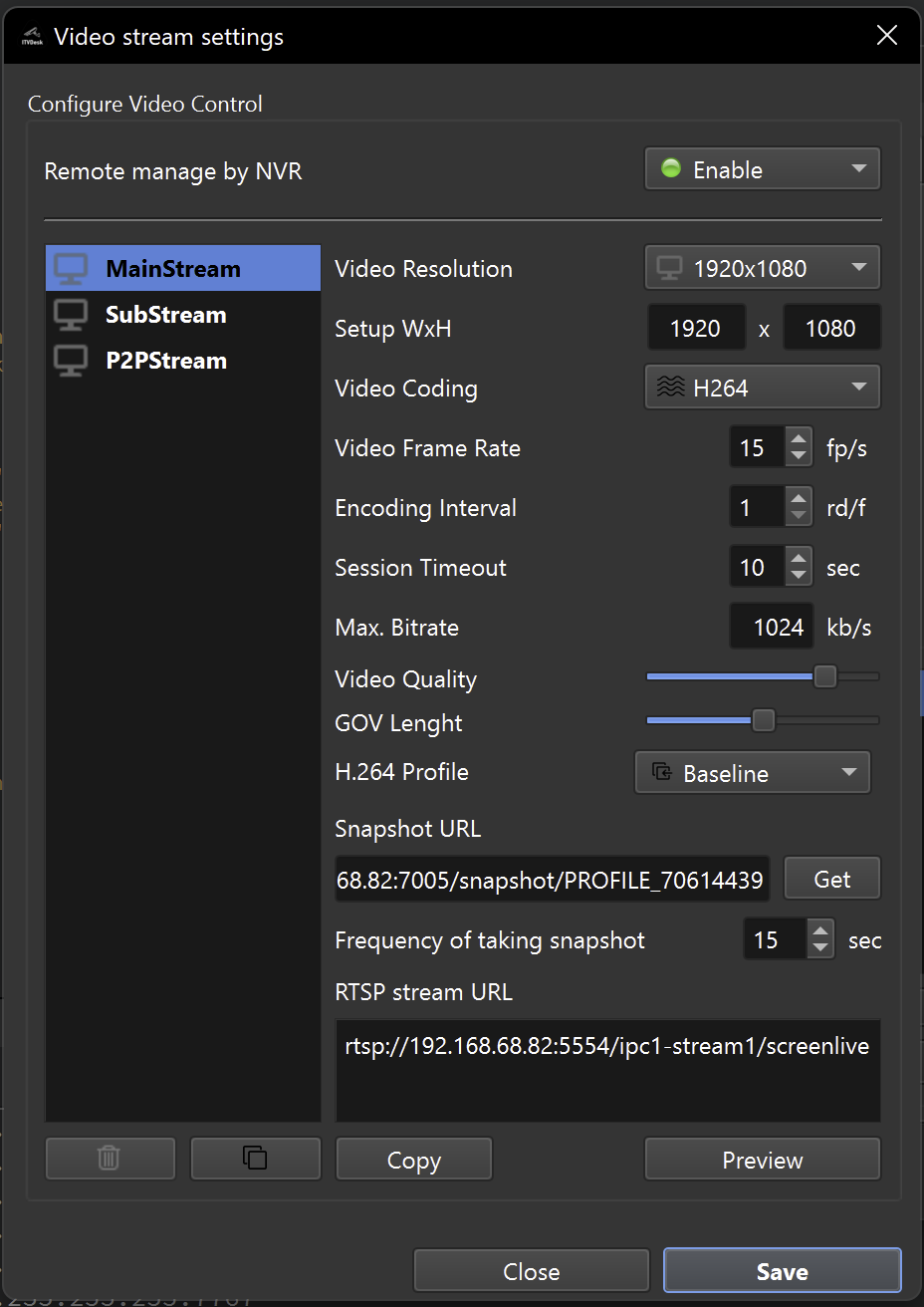
What the main settings mean
| Setting | Purpose | Practical guidance |
|---|---|---|
| Stream profile | MainStream, SubStream, or P2PStream profile exposed to ONVIF and RTSP clients. | Use MainStream for recording. Use SubStream for preview, mobile, WAN, or low-bandwidth viewing. |
| Resolution | Video size, for example 1280x720, 1920x1080, or 3840x2160. | Higher resolution gives more detail but uses more CPU/GPU, network, and recorder storage. |
| Codec / Profile | Controls video compression and compatibility, such as H.264, H.265, MJPEG, and H.264 profile. | H.264 Baseline is usually the safest choice for maximum NVR/VMS compatibility. H.265 can reduce bandwidth when supported. |
| FPS | How many frames are encoded each second. | 10 FPS is often enough for monitoring. 15 FPS is balanced. 25/30 FPS is smoother but heavier. |
| GOP / Encoding interval | Controls how often keyframes are generated. | Shorter GOP can improve seeking and snapshots. Longer GOP can reduce bitrate. Change only when needed for recorder compatibility or support tuning. |
| Max bitrate | Limits how much network bandwidth the stream can use. | Increase only if video details are missing. Reduce if the stream is delayed, network is busy, or the recorder is overloaded. |
How to change video quality settings in ITVDesk
- Open ITVDesk.
- Go to Setup ONVIF IP Camera.
- Select the virtual IP camera and the channel you want to tune.
- Click Video stream or the encoder/settings button for the selected stream.
- Select the stream profile you want to change, for example MainStream or SubStream.
- Adjust resolution, codec/profile, FPS, GOP / encoding interval, bitrate, or quality as required.
- Use Preview & Test to confirm the stream before adding or refreshing it inside the VMS/NVR.
- Check live view and recording directly in the real VMS/NVR environment.
Typical starting values
- General recording: 1920x1080, H.264, 15 FPS, balanced bitrate.
- Low bandwidth preview: 1280x720 or lower, H.264, 10 FPS, reduced bitrate.
- High detail / 4K: test GPU_ZERO or hardware-assisted encoding and verify recorder decoding capacity.
- Maximum compatibility: H.264 Baseline profile before using H.265 or advanced profiles.
Change settings from ITVDesk Web Management
If Web Management is enabled, the same stream profile settings can also be adjusted from a browser on the local network. This is useful for administrators who manage ITVDesk remotely or need to fine-tune a camera without opening the local desktop application.
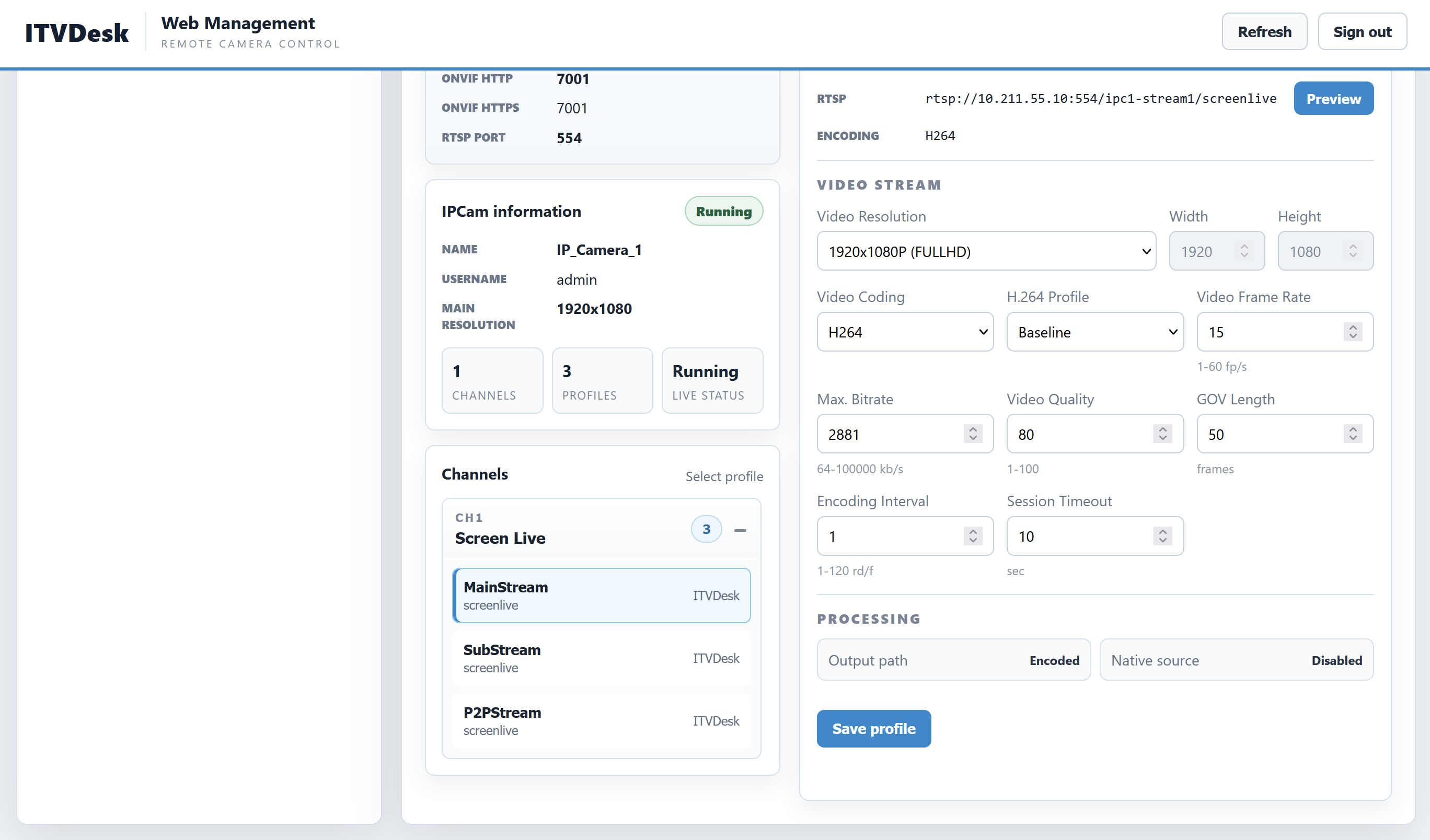
After saving changes from the web panel, verify the stream with the built-in preview and then test live view and recording in the connected VMS/NVR.
MainStream, SubStream and VMS/NVR behavior
Many VMS/NVR systems use the MainStream for recording and the SubStream for preview or multi-camera grid views. ITVDesk exposes profiles through ONVIF and RTSP so the recording system can select the stream it supports.
If a recorder does not display video, first test the MainStream with H.264 Baseline and moderate settings. After the stream is stable, increase resolution, FPS, bitrate, or switch to H.265 only if the recorder supports it correctly.
Performance and bandwidth notes
- Higher resolution, FPS, bitrate, and quality increase CPU/GPU load, network use, and storage consumption.
- Use GPU_ZERO or hardware-assisted encoding where available for high-resolution or multi-stream deployments.
- Use optimized CPU encoding when GPU acceleration is not available or not required.
- For multi-channel ITVDesk configurations, tune each channel according to its real recording purpose.
- For protected or remote networks, verify bitrate and latency before production use.
Troubleshooting poor quality or unstable video
- If video is delayed or choppy, reduce FPS first.
- If the network or recorder is overloaded, reduce bitrate or resolution.
- If image detail is poor but playback is stable, increase bitrate gradually.
- If the VMS/NVR cannot decode the stream, switch to H.264 Baseline and test again.
- If snapshots or seeking are slow, test a shorter GOP / encoding interval.
- Always test with the actual recorder model because not all VMS/NVR systems support the same profiles, codecs, frame rates, or resolutions.